


Accountants are already in the AI conversation, whether you meant to be or not. Conferences are saturated with “AI‑powered everything,” and every week another tool promises to transform your firm.
Yet underneath the hype, most firms aren’t racing ahead. They’re parked in the same place — curious about AI, but not confident enough to let it near work they sign, let alone build a new operating model around it.
Your caution is not the problem to be “fixed.” It’s the professional instinct you need to design around so AI becomes an advantage, not a liability.
Accountability, not technology, is the real barrier
From the outside, it’s easy for tech folks to shrug and say, “The tools are ready; firms just need to get on board.” But inside firms, the questions are different:
“If an AI system drafts this work and something is wrong, am I still signing?”
“If the agent misclassifies, miscalculates or misses an edge case, who is actually on the hook?”
“If AI touches the books, can I still stand behind the engagement the same way?”
In accounting, you don’t get to blame the system. You sign the work, so you own the result regardless of which platform prepared it. That simple fact changes the entire AI conversation.
AI can’t be treated like a trendy gadget or a lab toy. It has to show up as an extension of your professional judgment. As something you’ll monitor, test and govern with the same rigor you apply to any other part of the engagement.
The real risk is AI without oversight
Uncontrolled AI is at the heart of concerns. The issue isn’t that a system can draft a reconciliation, propose a journal entry or categorize transactions. The danger is when those actions happen quietly in the background with no boundaries, no audit trail and no clear review step.
When automations post directly to the GL or push information to clients without human oversight, you quietly drift from “AI‑assisted work” to “AI‑substituted work.” And that’s exactly the scenario that triggers every concern about accountability.
The safer — and smarter — way to think about AI is simple:
AI prepares the work
Accountants review, challenge and approve
Nothing posts or goes out the door without human sign‑off
Puzzle is a good example of an AI-native accounting platform intentionally leaning into this “AI prepares, humans approve” model. Instead of hiding AI in the background, Puzzle brings AI agents to the front of the experience so firms can see exactly what each agent is doing, where it stopped and what requires human review.
When you design your AI for accountants, you get the speed without sacrificing control.

Shifting the mindset from autonomous to AI-led
A lot of AI marketing is built around speed, not accountability. You’ve seen the claims of a fully automated close or hands‑free reconciliations. But for a profession that signs its work, that’s a red flag, not a selling point.
Many tools fall short for firms because they treat governance and controls as an afterthought instead of a core requirement. By contrast, tools that resonate with accountants lead with governed automation accountant-approved workflows, offering clear checkpoints for review and approval.
Considering all of this, it’s truly a mindset shift that needs to occur first — one from autonomous automation to accountant-approved AI. The first takes humans out of the loop, while the latter keeps accountants not only in the loop, but in control.
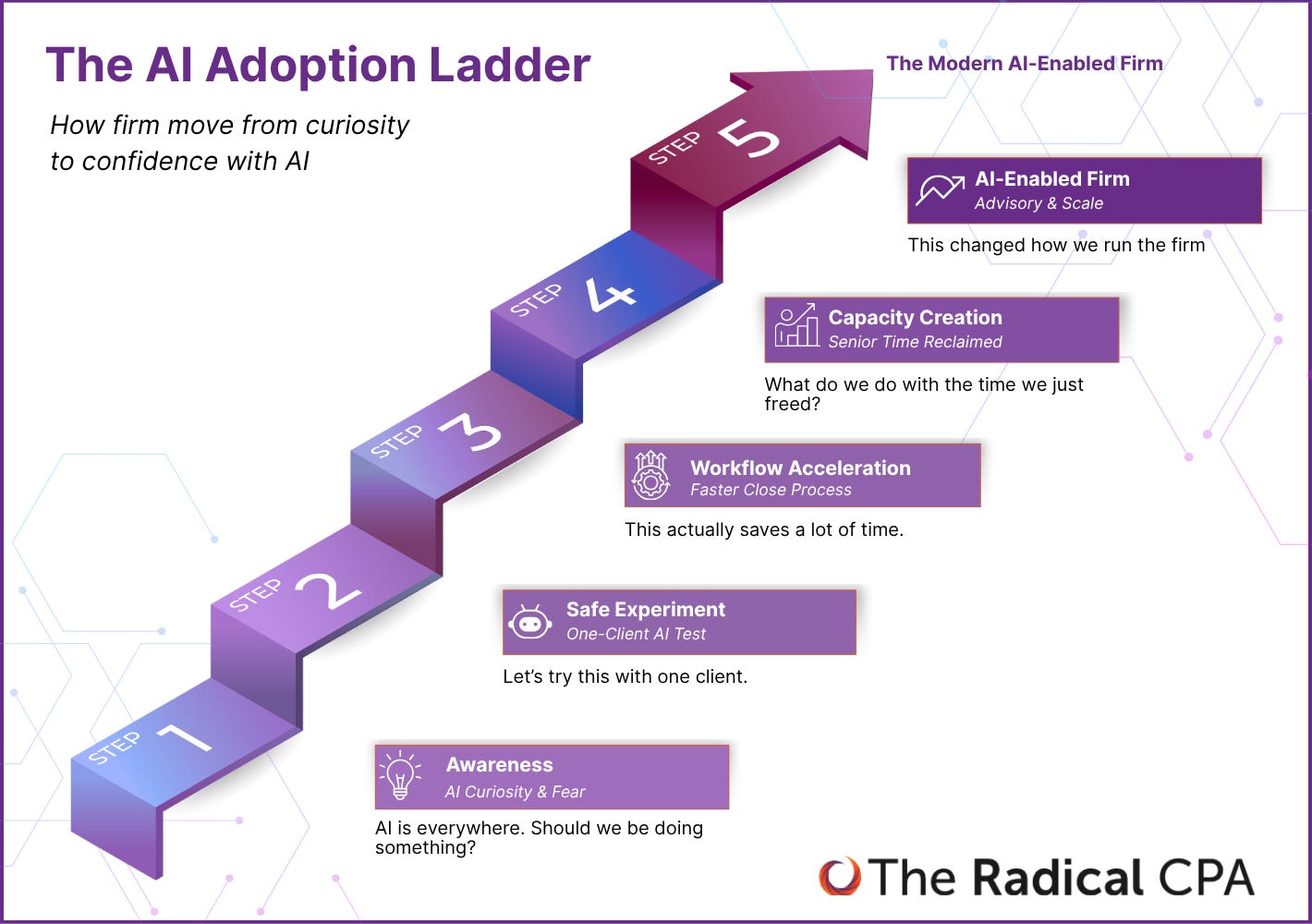
The AI Adoption Ladder
Adopting AI is not an overnight decision. Successful firms progress at a steady, intentional pace. Consider each rung of the Adoption Ladder:
Intentional adoption is key
AI is real and it’s here. However, firms should not adopt it without an intentional strategy in place.
That strategy starts with setting an important goal: AI does not remove accountants from the process, but rather it changes what they spend their time on. When AI prepares work faster and more consistently, accountants can stay focused on what only they can do, like review, interpret, advise and sign.
