Most firms stall on AI because the first step feels overwhelming. Leaders imagine a firm‑wide rollout, a system migration and a complete process overhaul, and then decide that they simply don’t have time for that.
The good news is that you don’t need a sweeping transformation. You just need to start small. Think of it less like flipping a switch and more like onboarding a new client or system.
Running the experiment in 5 steps
A small experiment solves three problems at once:
It keeps risk low because you are not changing everything at once
It makes learning real because you are working with actual data, actual deadlines and real client expectations
It builds trust because your team can see where AI helps and where it requires tighter rules
Starting with one to five clients is the sweet spot for most firms. Even with a small group, you can start to see repeating issues, recurring wins and the beginnings of a playbook you can standardize.
Running this as a proper experiment also means keeping your existing processes intact.
Most firms feel safer running parallel systems for a while, meaning that your legacy GL and workflows stay live while you spin up an AI‑enabled version of the process for the same five clients and compare results side‑by‑side.

Step 1: Choose 1-5 simple clients on purpose
The experiment begins with picking the right clients. You’re not looking for your most complex, dramatic or high‑risk engagements. You want stable, predictable clients where a new workflow can be tested calmly.
Look for clients who are:
Operationally stable: Those with a consistent business model
Data‑reliable: Those with reasonably clean books
Relationship‑strong: Those who trust you and will be comfortable as part of the experiment
Your mindset: You’re not rolling out AI to the whole firm; you’re running a controlled experiment with clients we know well.
Time commitment: Partners/managers: 1–2 hours to select clients, set guardrails and brief the team. Team: 1–2 hours per week in the first month for workflow changes, vendor sessions and debriefs.
Steps 2 and 3: Map the workflow, then give agents specific jobs
Before AI enters the picture, you have to be crystal clear on how the work gets done today. For each of the five clients, map the end‑to‑end flow start to finish. A monthly close might look like this:
Pull data from bank feeds and accounting system
Classify transactions
Reconcile accounts
Prepare schedules and workpapers
Review, adjust and finalize reports
As you map, circle the steps that are highly repeatable, rules‑based and time‑consuming. Those are the pieces you want AI agents to draft under strict governance.
From there, you define agents as “digital staff with job descriptions,” not magic bots. Here are a few examples:
An agent that classifies routine transactions using firm‑approved rules and history
An agent that drafts reconciliations for specific accounts
An agent that assembles standard workpapers from multiple data sources
An agent that flags anomalies or exceptions that do not fit the usual pattern
Tools like Puzzle make this easier by allowing firms to build agents in minutes with plain English. You decide what the agent can do, what it can propose and where it needs human approval.
Mindset to remember: AI should plug into a process you understand. It cannot fix a process you never documented. Agents are here to handle repeatable steps and not to own the engagement.
Time commitment: 1–2 minutes per agent build (often reusable across similar clients) and 30–60 minutes with your tech partner to validate where agents make the most impact. Add 1–2 hours in the first month to refine rules as you see real behavior.
Steps 4 and 5: Review AI like staff work, then scale only what you trust
Once agents are drafting pieces of the work, your experiment is well underway. One rule, however, is a non‑negotiable. AI can prepare the work, but it cannot post, file or be delivered to a client without human review.
Your team should review AI output the same way they would a junior team member’s work:
Check accuracy and completeness
Look for patterns in recurring errors
Compare time spent reviewing now to the time previously spent preparing from scratch
This review step is where trust is built. Teams see exactly where AI is strong, where it needs clearer instructions and where it should not be used at all.
As you gather experience across the five clients, start writing down what you learn: which tasks agents handle well; where predictable mistakes occur; and which prompts, rules or configurations deliver the best results. From there, tighten your setup: clarify boundaries; add rules for common edge cases; and decide which tasks are ideal for agents, which are shared and which stay fully human for now.
By the end of the experiment, you should be able to identify how much time was saved, if quality improved and if your team is ready to expand to more clients.
Mindset to remember: This isn’t about proving AI is perfect. It’s about finding where AI reliably helps and baking that into how you work.
Time commitment: 1–2 hours per month to review metrics and feedback across the five clients, plus a short internal debrief at the end to decide what to standardize and what to try next.
How this moves you up the AI Adoption Ladder
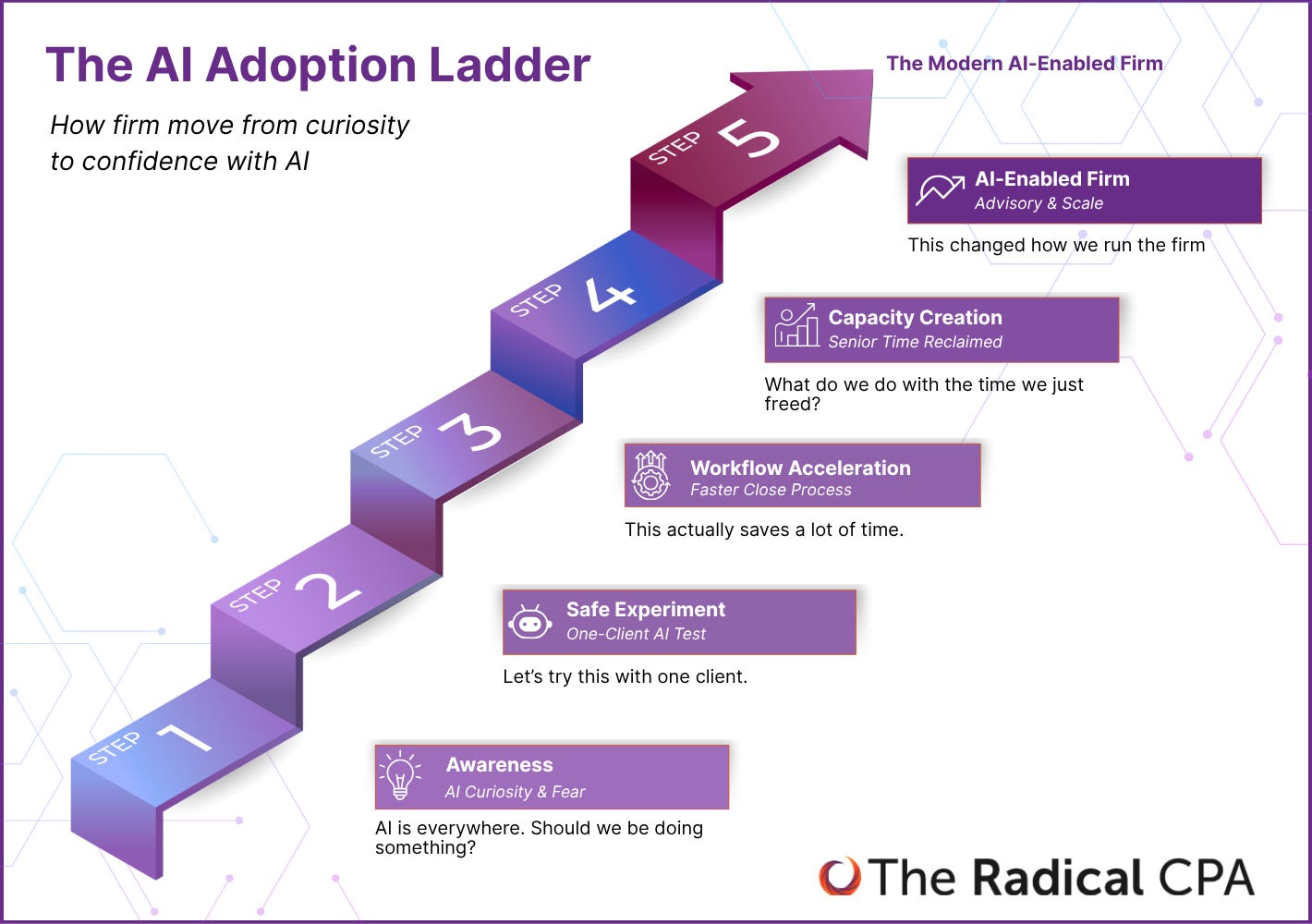
Decisions around AI adoption take time as firms begin with awareness and move toward being an AI-enabled firm, as shown on the AI Adoption Ladder below. The 5‑Client AI experiment sits on the Experimentation rung of the AI Adoption Ladder but nudges you toward Adoption and Integration.
You’re not talking about AI in theory anymore. You’re using it in live work, with clear guardrails, and learning what’s worth scaling.